
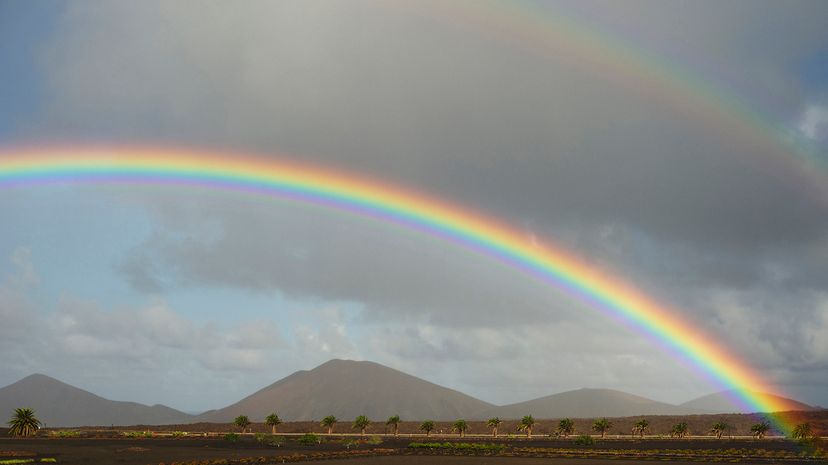
When you hear the word "rainbow," maybe you think about the clouds parting at the end of rainy day, or a Pink Floyd album cover, or a mythical pot of gold. But how are rainbows formed? The science is pretty straightforward.
Advertisement
When you hear the word "rainbow," maybe you think about the clouds parting at the end of rainy day, or a Pink Floyd album cover, or a mythical pot of gold. But how are rainbows formed? The science is pretty straightforward.
Advertisement
It all starts with a prism. Imagine a triangular piece of glass or plastic. This prism is like a backstage magician in the rainbow-creating show. When white light enters one face of the prism, it's as if the magician whispers an incantation: "Separate!"

You see, light enters the prism, and the magic begins. This process of splitting is thanks to the refractive index of the glass. What's that, you ask? Every material, from air to water, has a different refractive index. This index dictates how much light bends as it travels from one medium to another.
Advertisement
When light hits the prism, it bends, or refracts, thanks to the change in refractive index between air and glass. But it doesn't stop there; as the light continues through the prism, it separates into its various colors.
We call this process dispersion, and it's how a spectrum of colors — from red light with the longest wavelength to violet light with the shortest wavelength — is created.
The colors of a rainbow are red, orange, yellow, green, blue, indigo and violet. It's the sequence you never forget: Roy G. Biv!
Advertisement
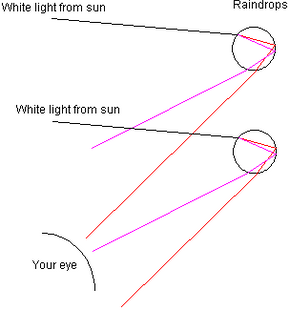
Good news: You don't need a prism to witness this spectral display. Mother Nature's got you covered with raindrops.
Yes, raindrops in the air act like tiny prisms.
Advertisement
Light passes through each water droplet, bending as it goes in and reflecting off the side before it exits. This sequence—entering, bending, and exiting—is a process called refraction.
To visualize how rainbows formed in the sky, think about the angles. Light entering a rain droplet bends at specific angles, depending on its color. Red light exits at an angle of 42 degrees, while violet is slightly smaller at 40 degrees.
The different angles from multiple droplets form a complete circle of color in the sky — our beloved rainbow. Ever noticed that most of the time, you see only part of the circle? That's because the ground gets in the way!
A double rainbow is what happens when light inside the droplets reflects twice, meaning you get a second reflection. The secondary rainbow appears outside the primary bow and has its colors reversed. If you're lucky enough to see one, it means the water droplets are just the right size for that second show.
In various cultures, rainbows are symbols of hope, usually representing the promise of upcoming rain. So the next time you see a rainbow, it's not just a scientific marvel — it's also a multicultural sign of good things to come!
Advertisement
To be scientifically correct, a rainbow is not an object but an optical illusion. What reaches our eyes is visible light, which gets processed by the human eye into the vibrant bands of color we associate with a rainbow.
Advertisement
Light is composed of photons — tiny particles that behave both as light waves and light rays. When light refracts, or bends, it does so because its light waves are interacting with the medium they're traveling through — be it air, glass, or water.
This article was updated in conjunction with AI technology, then fact-checked and edited by a HowStuffWorks editor.
Advertisement
The next time you spot a rainbow, you will see it in a whole new light. For more information, check out How Rainbows Work.
Advertisement
Please copy/paste the following text to properly cite this HowStuffWorks.com article:
Advertisement