Dive, Dive, Dive! Life Onboard a Sub
A Trident nuclear powered submarine has a crew of 165 and is on patrol (at sea) for about 240 days per year. Surprisingly, the most junior crew members, supervised by senior officers, are the ones who actually "drive and dive" the submarine.
More than 50,000 meals are served during each 60-day sea patrol! That means a lot of food must be stored on board. Meals are served four times a day -- breakfast, lunch, dinner, and midrats (midnight rations). There is only one galley (kitchen), so the space must be used very efficiently. Officers and crew eat the same food and are on a five-week cycle menu. Typical meals range from grilled steaks and chicken to pizza, lasagna, and salads.
Being on patrol for more than two months creates a lot of trash. Each day the ship's crew produces about the same volume of trash a family of four does in a month. Submarine operators must find a way to manage this waste. They use a powerful trash compactor and disposal unit to squeeze each day's trash into two or three small cans about the size of a fire extinguisher!
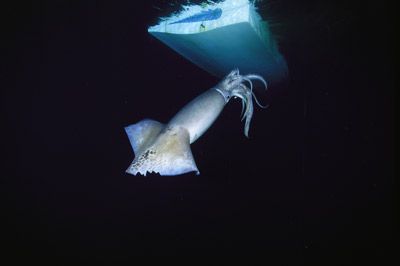
Since a submarine has no windows, periscopes are the only way to actually see a "contact" or another ship when it is underwater. But periscopes only work near the surface. A technology called sonar becomes the real eyes of the submarine. Sonar emits pulses of sound waves that travel through the water, reflect off the target and return to the submarine. At times, understanding sonar signals can be quite tricky because fish and whales also make sounds, masking the noise from other ships
|
How Submarines are Powered
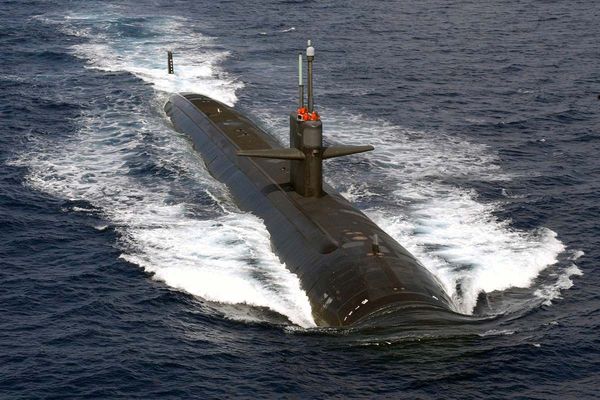
Over the years, engineers have used a variety of sources to power submarines. However, it was not until 1955, when nuclear power was first used on the USS Nautilus, that subs were able to patrol beneath the surface for months at a time. Electric batteries, while important for backup power, simply did not last long enough. The British sub Porpoise had thousands of battery-cells, but could only pro-vide power for two or three days. Diesel engines were powerful, but required a fresh air supply, so were only useful on the surface. Like other power sources, nuclear reactors create heat, which makes steam to drive electric generators (for heat, lights and equipment) and to power the turbines that make the propellers turn. Since nuclear reaction does not require an air supply, it has proven to be a superior source of power. The Ohio-class nuclear submarine, shown on the cover, refuels only once every nine years!
|
On a Trident submarine, nine crew members share a bunk room. The rooms are quite small and are nestled between missile tubes! Since space is so limited, crew members must fit all of their personal items in a four-inch deep bunk pan under their rack (bed). The submarine has just four showers for a crew of 165. Because fresh water is precious, there's not a lot of extra water for showers. That's why crew members take "submarine showers." This consists of quickly turning the water on to get wet, turning the water off and lathering up, and then turning the water back on to rinse off. About 40 people take showers before each watch, so there isn't much time to enjoy a shower anyway!
|
Make Your Own Sub
This experiment shows how to make a simple device that works like a submarine. You’ll learn about buoyancy and have some fun! It’s called a Cartesian diver, named after the French scientist Rene Descartes.
Here’s what you’ll need:
- A clear plastic soft drink bottle with a cap (16 ounces or 2 liters)
- A small test tube or eye-dropper that can fit through the bottle opening
- Water
Fill the bottle with water and then fill the tube about three-quarters full with water. Angle the bottle a little and drop the tube in upside down. It should barely float. You may have to adjust the amount of water in the tube to get it right. With the inverted tube in the bottle, top off the water and cap the bottle tightly. Except for a small amount of air in the tube, there shouldn’t be any air inside the bottle. To work the diver, squeeze the side of the bottle and observe what happens. Next, release the bottle and observe what happens.
|
<< Prev Next >> |