
|
|
|
A Blockbuster Budget

Action!
|
A movie starts with an idea. It could be a basic outline, or it could be a fully written screenplay. The idea/screenplay is promoted until a studio or independent investor decides to purchase the rights to it. Then, hundreds of people, maybe thousands are brought together to make the film. Stay to watch the movie credits and you know this. There are the cast, the supporting cast and the extras. There are all the hair stylists and makeup people. There are all the assistants to the cast members. There are the casting agents who hired the cast. There are all of the directors - the main director, the first assistant director, the second assistant director, the second unit director, the director of photography, the art director, the assistant art director, and so on. There are the producers. There are the screenwriters. There are the costume designers, costume makers, set designers and set crew. There are the camera operators and lighting crew. There are the special effects and visual effects people. There are the music people. There are the editors. There is the financial and legal staff. There are the caterers and drivers. The list goes on and on. All of these people work on the movie and they all must be paid. And, besides the wages for all these folks, don't forget other expenses, like the building supplies for the set, the furniture, the props, the costumes, the electricity, the advertising, etc.

|
Once the movie is completed, the film is sent to the studio. The studio makes a licensing agreement with a distribution company. The distribution company determines how many copies (prints) of the film to make. These are the actual films the movie theaters show to you. A print typically costs between $1,500 and $2,000 to make. Major films, like the "Star Wars" films or "The Lord of the Rings" trilogy have what is known as a "wide release." This means that the films open on 700 to 3,000 or more screens. That could mean a cost of more than $6 million on the prints! Smaller or independent films can have a "limited release," which means opening on 50 to 700 theaters. So the print costs are much smaller.
The distribution company screens (shows) the movie to prospective buyers representing the theaters. The buyers decide which films they want to show at their theaters. They will have to lease these films from the distributor. Then the buyers negotiate the terms of the lease agreement. To do this, first the theater negotiates the amount of the house allowance (also known as the "house nut"). This is a set figure to cover basic operating expenses each week. Next, the percentage split for the net box office (the amount left after the deduction of the house nut) and the percentage split for the gross box office are set. Usually, the net is set at something like 90 percent to the studio and 10 percent to the theater. Gross would be something like a 70/30 split for the first two weeks, followed by 60/40 for week three and 50/50 for week four. The arrangement is usually set up so that the distributor gets the highest possible amount, either net or gross -- whichever is greater. Finally, the length of the "engagement" is set. An engagement is the number of weeks a theater will show a film. A typical engagement is four weeks.
The prints are sent to the theaters a few days before the opening day. At the end of the engagement, the theater sends the print back to the distribution company and makes payment on the lease agreement.
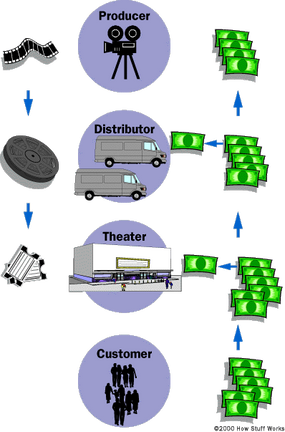
That gives you an idea why ticket prices are so high. But, what about the concessions? As you've seen, the studio spends a lot of money to make a film. And, the studio gets the majority of ticket money to recoup those expenses and then some. Theaters also have expenses. There are many costs involved in running a movie theater. The building itself costs money - either through a lease or mortgage payments. Then there are the utilities like electricity and water and the cost of equipment like projection systems, popcorn machines, and drink machines and so on. The theater also has to pay its employees.
Since they're not making much from ticket sales, the theater needs to make money another way. Movie studios and theaters both have other revenue streams. For example, think of merchandising for a movie - toys, action figures, books, video games - it all generates money for the studio. Theaters have two other main sources of revenue - concessions and pre-movie, on-screen advertising. While the advertising can generate some decent money, it's the concessions that can bring in the most revenue. When you look at the big picture, you can see that it's really the popcorn, soda and candy that keep theaters in business!
Try This!
Use this Web site: http://www.the-numbers.com/movies/records/index.html to verify the "All Time U.S. Top 20" movies listed below. These films have made the most money in the United States so far. The movies are arranged from highest to lowest earner.
Next, go to this Web site: http://www.oscars.org/awardsdatabase/index.html and, using your Top 20 list, find out how many Oscar® nominations and Oscar wins each movie has earned. Create a bar graph to chart your results. Now, examine your graph. Is there a relationship between earnings and Oscar nominations and/or wins? Use the Internet to find other information about these films, such as the MPA rating. Find out how many films are rated "G," "PG," "PG-13" and so on. Does there seem to be any relationship between ratings and earnings? What about ratings and Oscar nominations or wins?
|
WebQuest Exercise
|
| Film Title |
Oscar Nominations |
Oscar Wins |
| Titanic |
14 |
11 |
| Star Wars |
|
|
| Shrek 2 |
|
|
| E.T. |
|
|
| Star Wars: Phantom Menace |
|
|
| Spider Man |
|
|
| Star Wars: Return of the Sith |
|
|
| LOTR: Return of the King |
|
|
| Spider Man 2 |
|
|
| Passion of the Christ |
|
|
| Jurrasic Park |
|
|
| LOTR: Two Towers |
|
|
| Finding Nemo |
|
|
| Forest Gump |
|
|
| Harry Potter & the Sorcerer's Stone |
|
|
| LOTR: Fellowship of the Ring |
|
|
| Lion King |
|
|
| Return of the Jedi |
|
|
| Independence Day |
|
|
| Pirates of the Caribbean |
|
|
<< Prev |